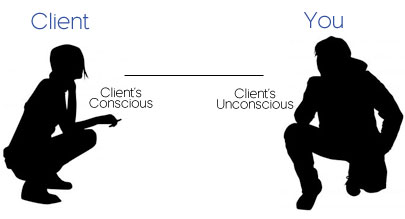
Here is a simple hypnosis and coaching technique for organizing communication spatially. When someone comes for hypnosis, part of the conversation often involves distinguishing deliberate, conscious thinking from more automatic responses. Spatial anchoring gives both the practitioner and the client a consistent way to represent that distinction.
During the pre-talk, you might indicate one area of the table while referring to conscious thought, then indicate another area while referring to unconscious or automatic processes. As the conversation continues, returning to those locations can make the distinction easier to follow and can strengthen the metaphor.
The gesture does not need to be explained formally each time. Its meaning develops through consistent use. Tonal shifts, eye direction, and gesture can all support that organization, provided they remain congruent with the client’s goals and the shared context of the session.
The unconscious space is closer to you, so it presupposes that if things come from that direction, they must be intended for the unconscious mind. You are essentially creating a submodality shift, by aligning things on a line, for which close to you means “unconscious” and away from you means “conscious”.
We can also indicate messages to be for the unconscious mind by using tonal marking and by referring to a visual location with our eyes (example: looking over the person’s right shoulder every time a message is meant for the unconscious mind)